


Proterial / Cable Solutions / Fiber Optic Cables / Indoor Tight Buffered Fiber Interconnect Cable
Proterial Cable America’s indoor tight buffered fiber optic cables are RoHS 3 compliant, and all multimode and singlemode cables (except OM1) use bend-insensitive optical fibers. Extremely flexible for easy handling, this lightweight fiber optic cable is made with aramid yarns to enhance strength. The 900 micron buffered design is recommended for easy termination to standard fiber optic connectors.
Our fiber interconnect cable is suitable for patch cords, short runs, and interconnects and will support applications including Gigabit, 10 Gigabit, and 40 Gigabit Ethernet. Proterial Cable America is proud to utilize Corning Optical Fiber as our standard tight-bend optical fiber.
Part Number | 60042-2, 60471-2, 61851-2, 60044-2 61379-2, 61457-2, 61986-2, 61378-2 60023-2, 60502-2, 61857-2, 60030-2 |
Manufacturing Location | This product is produced and manufactured in the USA |
Cable Rating | Plenum (UL) OFNP c(UL) OFNP FT6 |
Glass Construction | Glass core with 125 micron cladding and 250 micron acrylate coating |
Overall Jacket | Flame-retardant thermoplastic |
Jacket Colors |
|
Applications |
|
Custom Options | Enhanced bend insensitive OS2 optical fiber is available (ITU-T G.657.B3 & G.657.A2) |
Storage Temperature | -40°C to +70°C (-40°F to +158°F) |
Installation Temperature | 0° to 60°C (32° to 140°F) |
Operation Temperature | 0° to 70°C (32° to 158°F) |
| Fibers | Cable O.D. inches/mm | 62.5 UM OM1 | 50 UM OM3 | 50 UM OM4 | 8.3 UM OS2 |
| 2 | 0.114” / 2.9mm | 60042-2 | 60472-2 | 61851-2 | 60044-2 |
| zip | 079” x .170” / 2.0mm x 4.3mm | 61379-2 | 61457-2 | 61986-2 | 61378-2 |
| zip | .113” x .235” / 2.9mm x 6.0mm | 60023-2 | 60502-2 | 61857-2 | 60030-2 |
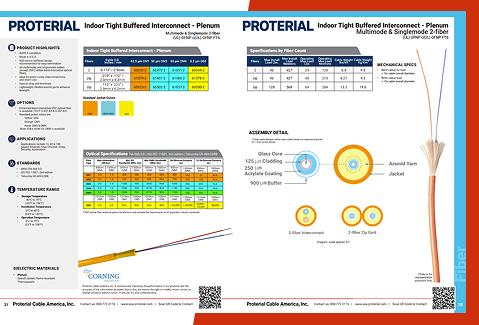
Tight buffered fiber optic cable has a 900-micron polymer coating applied directly over each optical fiber, making the fiber robust, flexible, and easy to handle. Loose-tube cable, by contrast, houses fibers inside gel-filled tubes with room to move, which better accommodates temperature swings outdoors. Tight buffered construction is ideal for indoor runs, patch cords, and terminations because it requires no gel cleaning and connects directly to standard fiber optic connectors without a furcation kit, eliminating an extra step that adds costs and time during installation.
Yes. The standard offering for this fiber optic cable product line is plenum-rated (OFNP), making it suitable for installation in air-handling ceilings, raised floors, and other spaces used for HVAC circulation, where building codes require low-smoke, flame-retardant jackets. A riser-rated version may also be appropriate, depending on the vertical path your run follows. Check local code requirements to confirm which cable rating applies to your system.
Four fiber types are offered:
The selection depends primarily on distance and bandwidth. For new applications supporting 10 Gigabit or 40 Gigabit Ethernet over distances up to ~100 m, OM3 or OM4 are the most cost-effective choices. OS2 singlemode is best for runs exceeding multi-mode distance limits or where future bandwidth scalability is a priority. OM1 is generally only recommended for legacy system compatibility.For example, a data center interconnect within a single building floor is a great use case for OM4, while a campus backbone linking multiple buildings would point toward OS2.
Four fiber types are offered:
The selection depends primarily on distance and bandwidth. For new applications supporting 10 Gigabit or 40 Gigabit Ethernet over distances up to ~100 m, OM3 or OM4 are the most cost-effective choices. OS2 singlemode is best for runs exceeding multi-mode distance limits or where future bandwidth scalability is a priority. OM1 is generally only recommended for legacy system compatibility.For example, a data center interconnect within a single building floor is a great use case for OM4, while a campus backbone linking multiple buildings would point toward OS2.
Four fiber types are offered:
The selection depends primarily on distance and bandwidth. For new applications supporting 10 Gigabit or 40 Gigabit Ethernet over distances up to ~100 m, OM3 or OM4 are the most cost-effective choices. OS2 singlemode is best for runs exceeding multi-mode distance limits or where future bandwidth scalability is a priority. OM1 is generally only recommended for legacy system compatibility.For example, a data center interconnect within a single building floor is a great use case for OM4, while a campus backbone linking multiple buildings would point toward OS2.
Bend-insensitive fiber, or tight bend optical fiber, uses a modified refractive index core profile that significantly reduces signal loss when the cable is routed around tight corners, bundled in conduit, or dressed through cramped equipment cabinets. Light traveling through a conventional fiber can leak out at sharp bends, degrading the signal reaching the receiver. Bend-insensitive construction withstands tighter routing without loss, producing better results in installations, particularly important for high-density cable trays and server rooms, where routing is rarely a straight point-to-point run. All fiber types in this line, except OM1, include this feature.
No. This fiber optic cable is designed exclusively for indoor use. It does not include a UV-resistant outer jacket, a moisture barrier, or armoring required to withstand outdoor, direct burial, or aerial applications. For outdoor runs, a separate outdoor-rated or armored cable should be used, with an indoor-rated cable beginning at the building entry point.
The round 2-fiber version is a conventional cylindrical cable. The zip-cord variants are dual-fiber cables bonded side-by-side and designed to separate or “zip” by hand, reducing termination time and costs when making two individual connections. The narrower zip offers flexibility in tight spaces, while the wider zip provides added durability and mechanical protection. The number of fibers and configuration you choose affects cable density in trays and conduits, so factor that into your system layout.
Let’s bring your project to life with the high-performance cables you need to drive innovation and build a better future.
Samples are available in 1m increments, up to 5m. Quotes are available for larger orders, available in 100m increments, subject to availability.