


Indoor outdoor tight buffered plenum fiber cable features a durable, UV-resistant jacket and is RoHS 3-compliant. All multi-mode and single-mode cables (except OM1) utilize bend-insensitive optical fibers. Dry, superabsorbent polymers (SAPs) eliminate water migration in cable interstices and feature a 900um buffered design recommended for easy termination.
The tight buffered outdoor fiber cable offers excellent flexibility and is suitable for lashed aerial, duct, underground conduit, and indoor plenum environments. Proterial Cable America is proud to utilize Corning Optical Fiber as our standard optical fiber.
| Manufacturing Location | This product is produced and manufactured in the USA |
| Cable Rating | Plenum (UL) OFNP c(UL) OFNP FT6 |
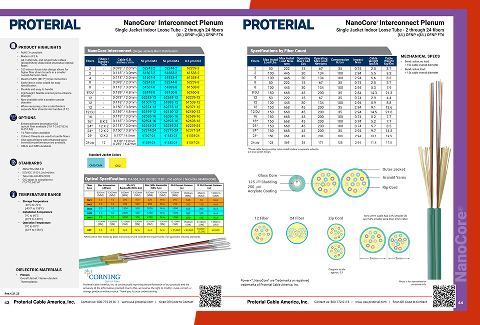
| Glass Construction | Glass core with 125 micron cladding, 250 micron acrylate coating, and 900 micron buffer. |
| Shield | None |
| Overall Jacket | Flame-retardant thermoplastic |
| Jacket Colors | Black |
| Applications | Applications include 10, 40 & 100 gigabit Ethernet, fiber channel, video, security, and automation |
| Custom Options | Enhanced bend insensitive OS2 optical fiber is available (ITU-T G.657.B3 & G.657.A2) |
| Storage Temperature | -40°C to +70°C (-40°F to +158°F) |
| Installation Temperature | 0°C to 60°C (32° to 140°F) |
| Operation Temperature | -40° to 70°C (-40° to 158°F) |
| Fibers | Cable O.D. inches/mm | 62.5 UM OM1 | 50 UM OM3 | 50 UM OM4 | 8.3 UM OS2 |
| 2 | 0.190” / 4.8mm 6 | 61460-2 | 61468-2 | 61894-2 | 61459-2 |
| 6 | 0.190” / 4.8mm | 61460-6 | 61468-6 | 61894-6 | 61459-6 |
| 12 | 0.230” / 5.8mm | 61460-12 | 61468-12 | 61894-12 | 61459-12 |
| 24 | 0.330” / 8.4mm | 61460-24 | 61468-24 | 61894-24 | 61459-24 |
| 48 | 0.627” / 15.9mm | 61979-48 | 61959-48 | 61980-48 | 61480-48 |
Tight buffered fiber optic cable has a 900-micron protective buffer applied directly over each fiber, making it easier to handle, strip, and terminate without additional fan-out kits. Loose tube cable, by contrast, encases fibers in gel-filled tubes and is typically better suited for long, direct-buried outdoor runs. If your project involves transitioning from outdoors into a building or requires easy field termination in both environments, a tight buffered cable like this is generally the preferred choice.
A plenum rating (OFNP) means the cable’s jacket meets strict smoke and flame safety requirements set by UL and the National Electrical Code (NEC). It is required by code whenever cable is routed through air-handling spaces, such as the space above a drop ceiling or below a raised floor used for HVAC airflow. If your cable path passes through any such space, plenum-rated cable is required by code. If the run stays entirely in conduit or non-plenum areas, a riser-rated cable may suffice.
The right fiber type depends on transmission distance and bandwidth requirements. OM3 and OM4 are multimode fibers that use lower-cost, LED or VCSEL-based transceivers and are well-suited for runs up to roughly 300m (OM3) or 400m (OM4) at 10 Gigabit speeds. OS2 is a single-mode fiber with essentially unlimited distance capability and is the standard choice for campus buildings, long inter-building runs, or any application where distances exceed what multimode can support. When in doubt for new infrastructure, OS2 future-proofs the installation.
Bend-insensitive fiber is engineered to maintain signal integrity even when routed around tight corners, through conduit bends, or in congested pathways where the fiber may be bent more sharply than conventional fiber tolerates. This cable uses bend-insensitive fibers across all multimode and single-mode types (except OM1), reducing signal loss in real-world installations and giving installers more flexibility when routing through trays, conduit, and junction boxes.
This cable is rated for duct and underground conduit installation, meaning it can be pulled through conduit underground. However, this tight buffered outdoor fiber cable is not designed for direct burial without a conduit. A gel-filled, armored, or direct-burial-rated cable would be required for that application. For aerial deployment, it is suitable for lashed aerial runs (attached to a separate messenger wire), but it is not a self-supporting aerial cable.
Instead of a petroleum-based filling gel (which requires solvent cleanup during termination), this indoor outdoor fiber cable uses dry superabsorbent polymers (SAPs) woven into the cable’s interstices. SAPs swell on contact with water to block moisture migration, while keeping the cable clean and gel-free. This significantly simplifies termination in the field and eliminates the mess and extra tools typically associated with gel-filled cables.
Fibers are color-coded for easy identification, and cables with more than 24 fibers are grouped into 12-fiber sub-units to keep high fiber count designs manageable during installation and termination. Standard fiber counts range from 2 to 144, with the product matrix on this page listing configurations up to 48 fibers. For higher fiber counts or custom configurations, including enhanced bend-insensitive OS2 fiber per ITU-T G.657.B3 or G.657.A2, contact Proterial Cable America directly, and a specialist can help determine the right configuration for your application.
Let’s bring your project to life with the high-performance cables you need to drive innovation and build a better future.
Samples are available in 1m increments, up to 5m. Quotes are available for larger orders, available in 100m increments, subject to availability.